How to test paint colours properly
17 July 2026 · 4 min read
Nearly every colour regret comes from choosing off a chip. The method that takes two days and prevents repainting a room twice.
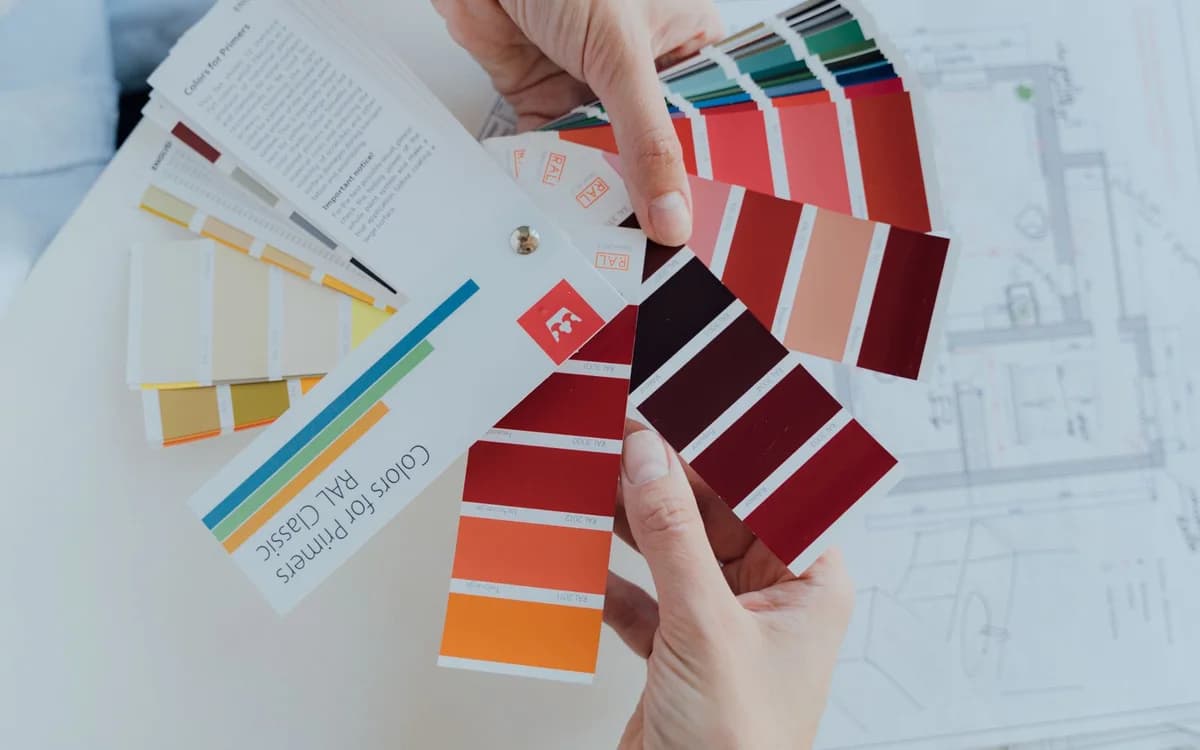
Colour is the only part of a painting job that is entirely your decision, and it is the part most often got wrong. Almost always for the same reason: the colour was chosen from something small, in the wrong light, next to the wrong things.
Why a chip cannot tell you
**It is tiny.** Colour intensifies with area. A grey that reads as a soft neutral on a card can be a definite blue across a whole wall. As a rule, expect a colour to be noticeably stronger at full size than it looked on the chip.
**It is surrounded by white.** That white border makes the chip look darker and duller than it will be. Remove the border and the colour lifts.
**It is in the wrong light.** Showroom lighting is nothing like your north-facing living room at four in the afternoon, or your kitchen under LED downlights at night.
**It is next to the wrong colours.** Colours affect their neighbours. Your beige carpet, your timber floor, your green garden through the window — all of it changes how the wall reads.
The method
**1. Narrow it down on chips.** Chips are fine for eliminating. Get to three or four candidates.
**2. Buy sample pots.** Every one of them. The cost is trivial against repainting a room.
**3. Paint large patches — A3 at minimum, A2 is better.** Two coats, so you are seeing the actual colour and not the wall through it.
**4. Paint them on more than one wall.** A north wall and a south wall in the same room will show the same colour very differently. If the room has a dark corner, put one there.
**5. Leave a white border.** Do not paint your patch directly against the existing colour — you will be judging the contrast, not the colour. A margin of white primer around each patch isolates it.
**6. Or paint boards instead.** Two coats on A2 pieces of white card or MDF, which you can move around the room, stand against the sofa, and hold near the floor. This is what designers do, and it is better than painting the wall.
**7. Look at it across a full day.** Early morning, midday, late afternoon, and at night under your own lights. A colour that is perfect at 10am can be muddy at 5pm.
**8. Live with it for two days minimum.** First impressions of colour are unreliable. Colours that feel exciting on day one are often the ones that feel exhausting on day three.
Test the ceiling colour too
People agonise over walls and default the ceiling to whatever white is on the tin. A ceiling occupies a large area, bounces light down onto every wall, and changes how the wall colour reads. It is worth ten minutes of thought.
Things people forget to check against
- The floor — carpet, timber or tile, and its undertone
- The kitchen benchtop and cabinetry
- Fixed tiling in bathrooms
- The window frames and doors
- What you can see through the windows
- The artificial lighting, and its colour temperature
That last one matters more than most people expect. Warm LEDs around 2700K and cool ones around 4000K make the same wall look like two different colours, and if the room is used mostly at night, that is the light that counts.
Exterior testing
Everything above, plus:
- Test on the actual elevation, not on a sample board held up
- Test on the **sunniest** wall, because that is where the colour will be most extreme
- Look at it against the roof colour, the paving, and the neighbouring houses
- Check it in the middle of the day and at sunset, when Perth's light goes strongly warm
The last check
Once you have chosen, get a sample pot of the final colour and paint a patch beside the last one you rejected. If you still prefer it after a day, order the paint.
Two days of testing against two days of repainting a room is not a difficult trade.