Why exterior paint fails in Perth, and how long you actually get
2 August 2026 · 5 min read
Chalking, flaking, blistering and fading all have different causes and different fixes. Here is how to tell them apart from the ground, and what each one means for the repaint.
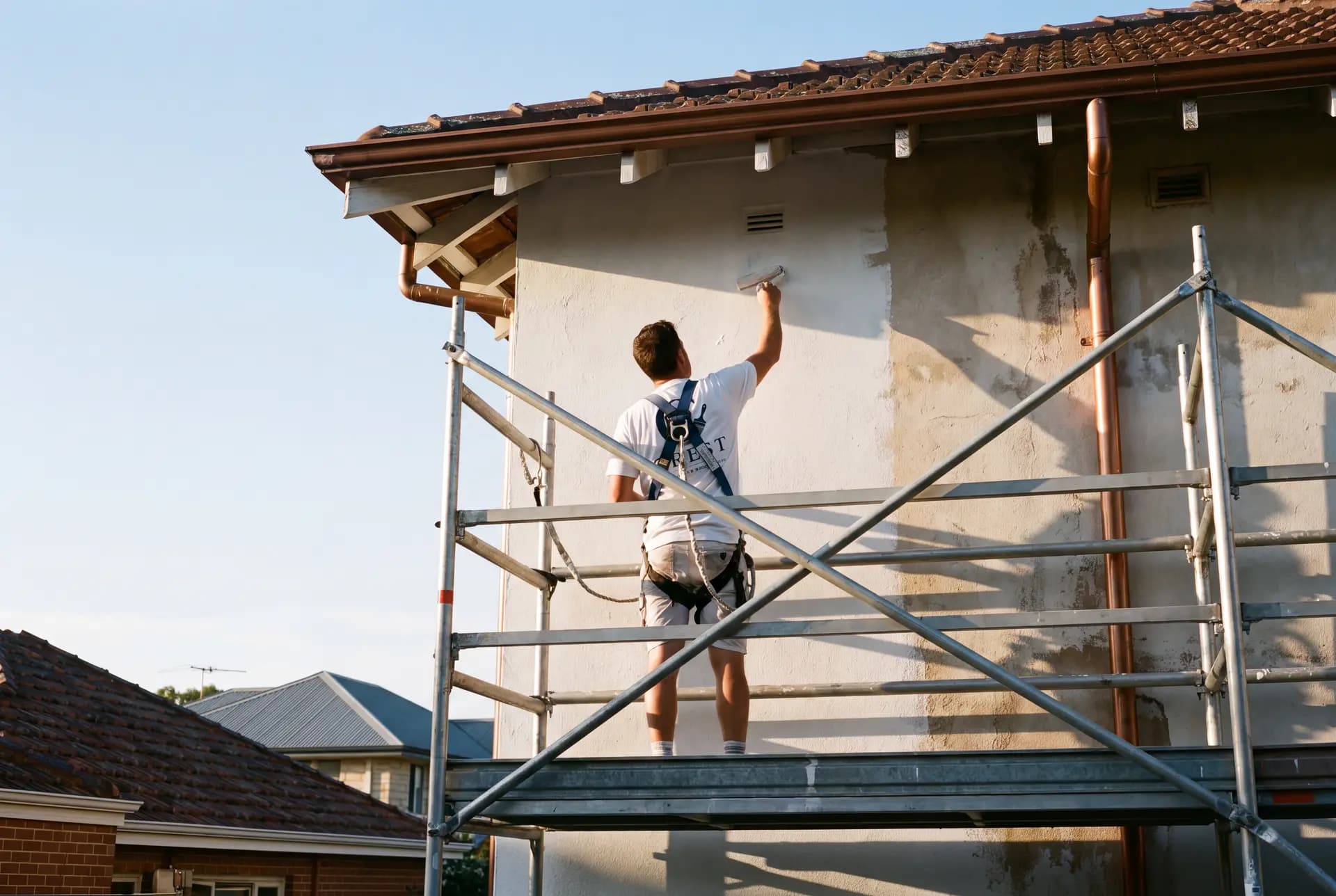
Perth is one of the harder climates in Australia for exterior coatings. It is not the heat on its own — it is the combination of very high UV, a long dry season that bakes the film, and a coastal salt load that reaches a surprising distance inland. A coating that would last twelve years in Melbourne can be visibly tired here in seven.
The useful thing is that paint fails in recognisable ways. If you can name the failure, you know whether you are looking at a wash and a recoat or a full strip.
Chalking
Run your hand down a north or west wall. If it comes away with a fine powder like coloured talc, that is chalking.
Chalking is the binder in the coating breaking down under UV, releasing the pigment it was holding. It is the most common failure on Perth exteriors and it is not, on its own, a disaster — the film is thinning rather than lifting.
Chalking is the one failure you can partly slow down
A wash every couple of years removes the loose pigment layer that is accelerating breakdown underneath. It will not stop chalking, but on a west wall it can buy you a year or two.
The problem with chalking is what happens if you paint over it. New coating bonds to the chalk, not to the substrate, and the chalk is already detaching. You get a repaint that looks perfect for eighteen months and then peels in sheets. Chalked surfaces must be washed back to a sound film and, if the chalking is heavy, sealed with a binding primer before anything else goes on.
Flaking and peeling
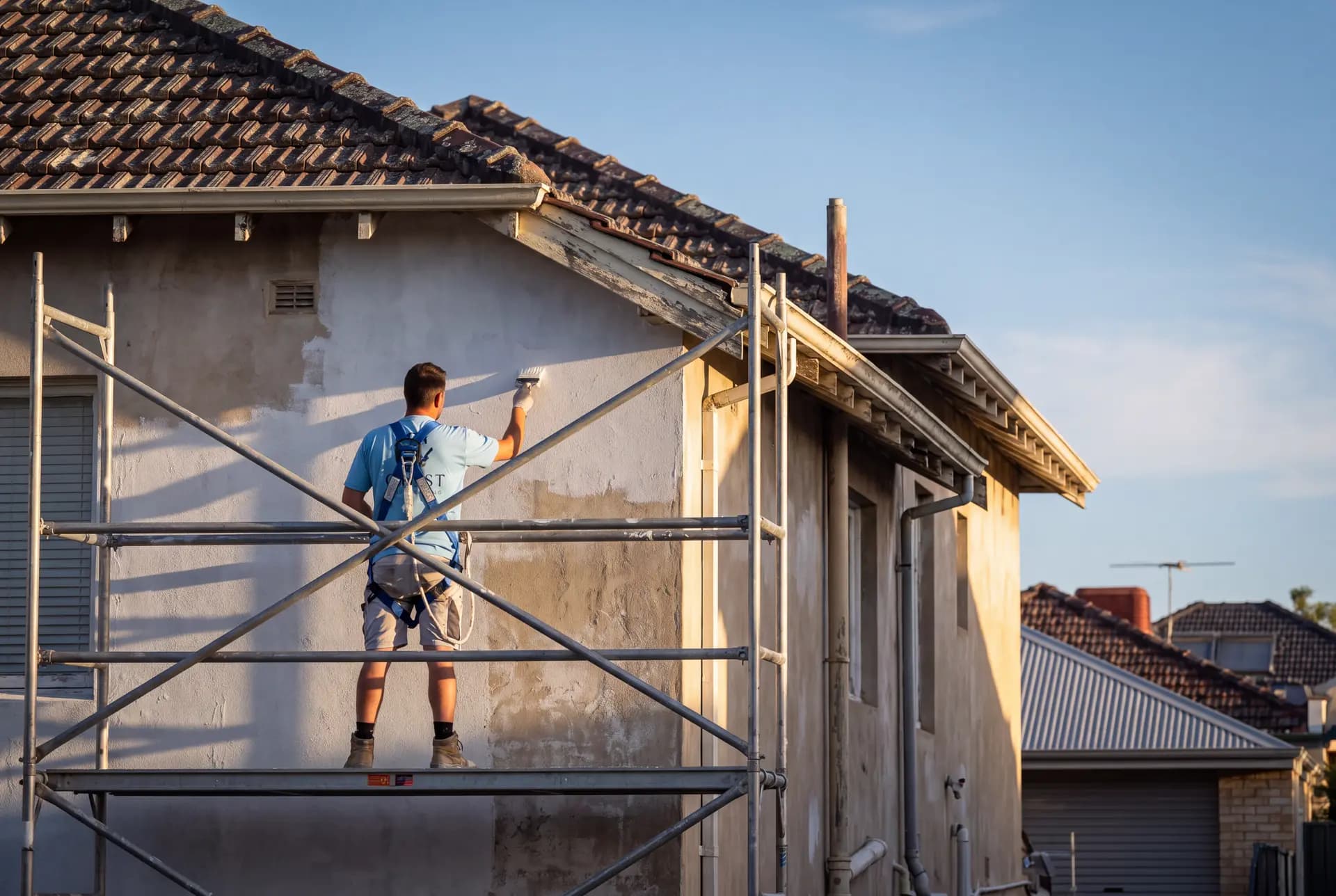
Flaking is an adhesion failure. The coating has let go of what is underneath it, which means either the surface was not prepared, or something is pushing the film off from behind — almost always moisture.
Look at the back of a flake:
- **Clean paint on the back, bare substrate underneath** — the coating never bonded. Poor preparation, or it was applied to a chalked or dusty surface.
- **Another layer of paint on the back** — the failure is between coats. Usually an incompatible system, or a recoat window that was missed by weeks.
- **Damp or powdery substrate** — moisture. Painting will not fix this and neither will better paint.
Blistering
Bubbles under the film mean something is trying to get out. On a wall that gets afternoon sun, small blisters that appear in summer and settle in winter are usually moisture vapour moving through the wall and finding the coating impermeable.
Blistering on a newly painted surface within days is different — that is solvent or moisture trapped by painting too soon, or painting a hot substrate. The manufacturer's temperature range is not a suggestion.
Fading
Fading is not a failure of adhesion, it is a failure of the pigment. Some colours simply do not last in this UV, and the difference between them is enormous.
Relative colour retention on a north-facing Perth wall
Barely visible change at ten years
Noticeable but even
Visible on the sunny elevation first
The organic pigments go first
The pattern is about pigment chemistry, not price. Inorganic pigments — the oxides that make earth tones, greys and whites — are far more UV stable than the organic pigments that produce bright reds, oranges and some blues. If you want a strong colour on a sun-facing elevation, ask specifically what pigment system it uses.
What you should actually expect
Realistic service life before a repaint is due, Perth metro
Those are ranges for a properly prepared job with a quality coating. A job that skipped preparation can fail in two.
Do not repaint over an active moisture problem
If the substrate is wet, no coating will hold, and you will have paid for the job twice. Rising damp, a failed perimeter seal, a leaking gutter or a downpipe discharging against the wall all need fixing before we can coat. We will tell you if we find one.
The honest summary
Most Perth exteriors are ready for attention somewhere between year six and year ten. Catching it at chalking rather than at flaking is the difference between a wash-and-recoat and a strip-and-rebuild, and that difference is often several thousand dollars.
If you are not sure which one you are looking at, send us a photo of the wall and a close-up of the worst patch. We can usually tell from that.